


Carp Retaining Slings: Do We Really Need Them?
Dernière mise à jour : 15 mars
Is It Time to Move Away from Them?
(Originally written for the French magazine Media Carpe)
When Christophe Courtois asked for an article on this topic, my first thought was: “Not you again…”
Because the last time I tackled something like this… I completely messed it up.
A Lesson from the Past
Around ten years ago, I wrote a six-part series about no-kill — what we now simply call catch and
release.
At the time, I felt like everything had already been said. Over and over again.
And yet, on the bank, it was still carnage.
So I tried a different approach. I went in hard — deliberately. The idea was to create a shock, to
wake people up. Because the truth is, small mistakes can have irreversible consequences.
But let’s be honest… it didn’t work.
For many reasons — one of them being that people don’t like being confronted with their own
contradictions.
A Softer Approach
So today, I’m taking a different route.
Not to lecture — but simply to remind.
Because with a bit of awareness and common sense, a lot of damage can easily be avoided.

40 Years of “Service”… but at What Cost?
The traditional carp sack — dark, sinking, made of fabric — has been around for decades. I’ve always known it as part of carp fishing.
Originally, it was designed for one simple purpose:
to retain a fish overnight so it could be photographed in daylight.
In reality, it’s nothing more than a modern keepnet for big carp.
And like many things in fishing, it’s been misused.
Multiple fish in one sack.
Poorly secured setups.
Homemade versions that turned into death traps.Mistakes were made — lots of them.
And today, thousands of fish carry the scars of those mistakes.
The least we can do is make sure it wasn’t all for nothing.
Do You Really Need a Retainer?
Retaining slings are widely used in carp fishing, but using a retaining sling for carp should never become automatic.
Think of it like a spare wheel in your car — something you have just in case, not something you
rely on every time.
The less you handle a fish, the lower the risk. It’s as simple as that.
If you’re fishing with a mate, take your photos at night.
With modern gear, it’s easier than ever.
And actually, it’s often better.
Right after the fight, the fish is calmer, easier to control, and safer to handle.
If you’re fishing solo, it’s still perfectly doable — just make sure everything is ready beforehand,
and pick your swim carefully so the process is quick and controlled.

Fish Care Basics (That Still Matter)
Whenever possible, keep the fish in the water during handling.
It protects the mucus layer and reduces stress, as the fish’s weight is supported naturally.
If you do need to bring it onto the bank:
– Keep it wet at all times
– Use water from the lake (not overheated or freezing water)
– Avoid temperature shocks
And of course, use a proper unhooking mat — thick, large, and safe.
There’s a lot of poor gear on the market, so common sense is still your best tool.
At the end of the day, the golden rule is simple:
THE QUICKER THE RELEASE, THE BETTER THE FISH WILL BE.
“Do as I Say, Not as I Do”
Let’s be honest — we’ve all been tempted to keep a fish for daylight photos.
But we have to remember: we’re dealing with a living creature we respect and admire.
Putting ego aside and finding balance is key.If it helps, keep in mind that night shots have their own charm — and they also protect your spots
from unwanted attention.
That said… I still occasionally retain fish myself.
Rain is usually the main reason — it can make night photography difficult.
But when I do, I follow strict guidelines.

Time Matters
I always consider how long the fish will stay in the sling.
Personally, anything beyond 6 hours starts to make me uncomfortable.
But context is everything.
Leaving a fish for 2 hours in June over rocks can be more dangerous than 8 hours in winter over soft silt.
You always need to factor in:
– water temperature
– time of year
– lakebed type
– weather conditions
And of course, your handling and equipment.
High-Risk Situations to Avoid
Some situations should immediately raise red flags:
Current (even slight)
If there’s no slack water, don’t do it. Fish can end up folded or pinned in dangerous positions.
Strong wind and waves
Waves create movement and can push the sling onto the bank violently. If you can’t place it deep
and stable, don’t risk it.
Concrete canal banks
Slippery slopes, boat traffic, and heavy undertow make these areas extremely dangerous.
Dense weed in low oxygen conditions
At night, weeds consume oxygen. In summer, this can become critical and lead to suffocation.
Rough or abrasive bottoms
Rocks, branches, sand — prolonged contact can cause serious damage.

Handling Still Comes First
Even in perfect conditions, poor handling can ruin everything.
You can have the best sling in the world — if you lift it carelessly, damage is very likely.
A Safer Approach
Before lifting the fish:
– Gently tire it inside the sling
– Let it settle and calm down
– Observe its breathing
Then:
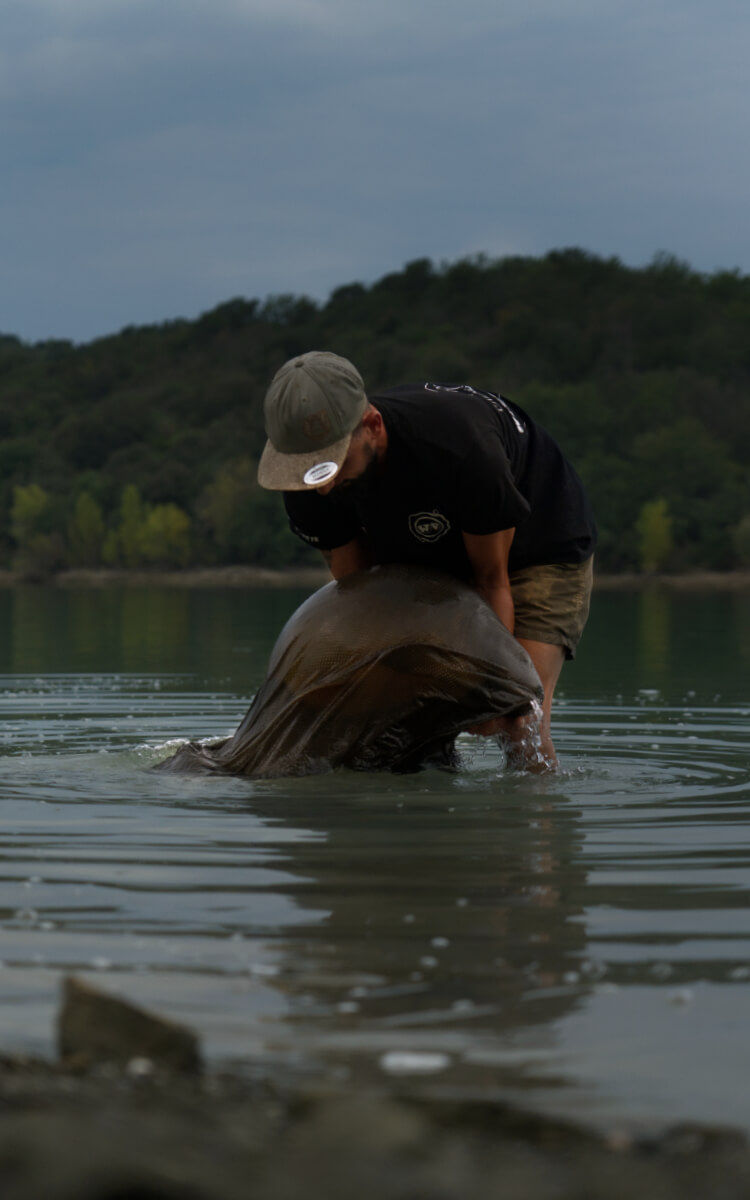
– Lift it in the water first
– Watch its reactions
– Only proceed when it’s calm
Finally:
– Open the sling carefully
– Be extra cautious around the head and eyes (light can trigger sudden reactions)
A calm fish is a safe fish.
Two Types of Slings — Two Very Different Uses
Sinking Slings
Best used as a last resort.
Simple, soft, non-abrasive materials are ideal.
Avoid relying on handles — they can fail, and they often put the fish in a bad position.
Always transport the fish properly supported, ideally in a weight sling.
Floating Slings
These are not retention tools.
They’re designed for very short-term use — an hour at most.
Used for longer periods, they can cause serious damage:
– fin erosion
– stress
– even injury if the fish tries to turn
I’ve experienced this myself.
A large, old carp severely damaged its tail trying to turn inside a floating sling.
At the time, I thought I was making the safer choice between sinking and floating slings.
In reality, I wasn’t.
The best option would have been to release it immediately.

Final Thoughts
Every detail matters.
And the best way to avoid accidents is simple:
stay aware, stay thoughtful, and learn from experience.
We all have the ability to read a situation.
And more importantly, we should share our mistakes — so others don’t repeat them.
That’s how we move forward.
There’s nothing wrong with evolving our mindset.
Soel
In the same vein, you might also enjoy:
Why Do I Fish? A Carp Fishing Philosophy
https://www.brakass.com/post/why-do-i-fish-a-carp-fishing-philosophy
Cultivating Your Dreams in Carp Fishing
https://www.brakass.com/post/why-do-i-fish-a-carp-fishing-philosophy
Catch & Release: Are We Really As Ethical As We Think?
https://www.brakass.com/post/catch-release-are-we-really-as-ethical-as-we-think


Commentaires